
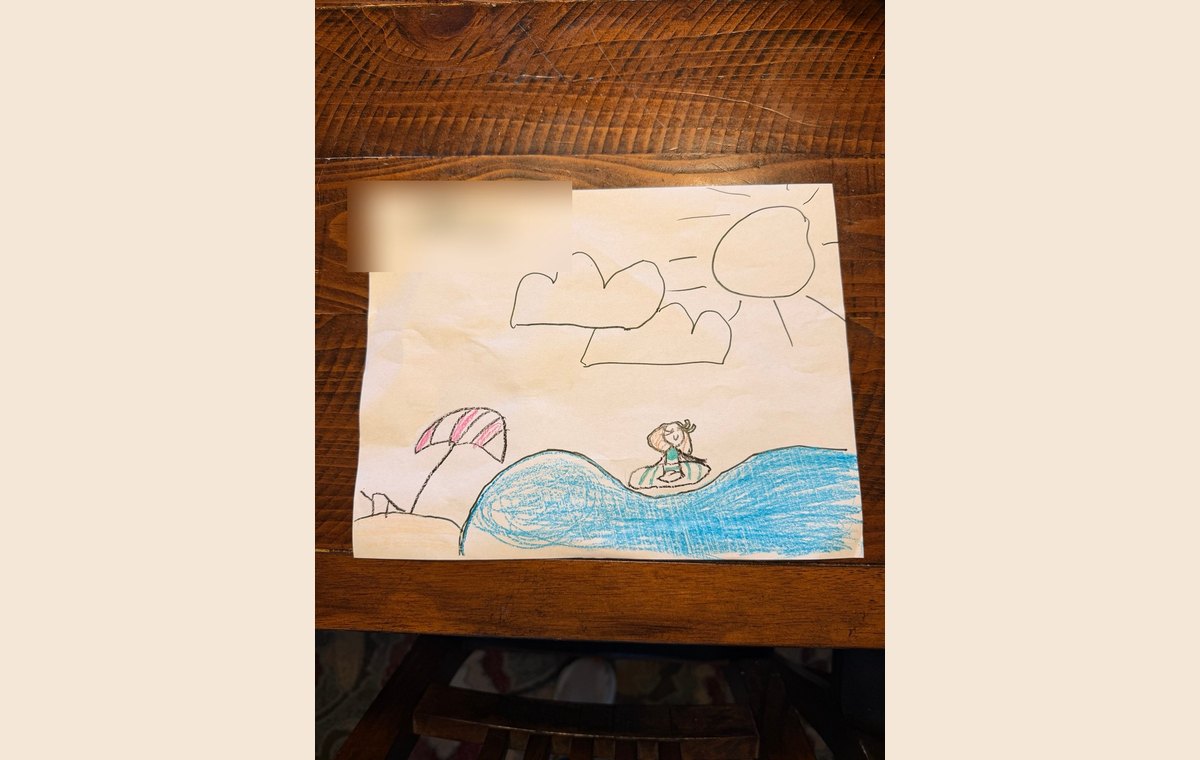
A child may draw a picture in five minutes and still have an entire story in mind. The most connecting response is often not praise about talent or a guess about what the picture means. It is simple curiosity that lets the child decide how much to share.
Start with an observation, not an interpretation
Try, “I notice a lot of blue here,” or, “You filled the whole page.” Avoid “That must be you” or “You look sad in this picture.” Adults can be confidently wrong, and a child may start correcting us instead of telling the story.
Ask one open question
“Would you tell me about your picture?” is enough. Other gentle options include “What is happening here?” “Which part did you make first?” and “What do you want me to notice?” Give the child time to answer instead of stacking five questions together.
Let the child pass
Some drawings are experiments, private ideas, or work a child does not feel ready to explain. A warm “You do not have to tell me” protects trust. Connection cannot be forced out of a piece of paper.
Follow the child’s words
If the child says, “This is the ocean,” ask about the ocean. Do not redirect immediately to color names, spelling, or whether the waves look realistic. The conversation can be about imagination rather than performance.
Resist fixing the art
Unless a child asks for help, avoid showing the correct way to draw a person, sun, animal, or letter. Questions such as “Why did you color it that way?” can sound like criticism. Try “Tell me about the colors you chose” instead.
Use the story to learn, not diagnose
A picture may reflect play, a book, a dream, a memory, or pure invention. One image does not prove what a child feels or what happened. If the child shares something concerning, stay calm, listen without suggesting answers, and seek appropriate professional guidance for safety or welfare concerns.
Protect the child’s privacy
Ask before displaying or sharing art outside the household when the child is old enough to participate in that choice. Crop or cover names, school information, addresses, schedules, faces, and other identifying details before posting. A proud family moment does not need to become a permanent public record.
Create a simple save-or-release routine
Let the child choose a small number of favorites for a folder or memory box. Photograph selected pieces if that fits the family, then recycle or release the rest as appropriate. The goal is not to keep every page forever; it is to treat the work respectfully.
End with specific appreciation
Instead of “You are such a great artist,” say, “I loved hearing how the boat got through those waves,” or, “You worked carefully on that part.” Specific attention tells a child the story mattered, not just the finished product.
For another gentle connection practice, try the five-minute one-on-one child check-in or this walk-and-talk connection guide.
Affiliate disclosure: No new affiliate recommendation was added because no relevant user-owned link completed destination, product, and attribution verification. As an Amazon Associate I earn from qualifying purchases.