

When the week is full, I do not want to do long division in a checkout line. I want one simple way to see whether two similar offers are actually different enough to matter. A calculator will not choose for you, but it can help the loudest discount sign stop making the decision.
First, make sure the offers are comparable
Compare the same product or a genuinely similar option, the same quantity, and the same delivery or pickup situation. A lower total for a smaller package may not be a better value. If quality, size, warranty, or return rules differ, write that down too; the lowest number alone does not decide what fits your family.
Do the discount math
For a percentage discount, multiply the regular price by the percentage you will pay. For example, a hypothetical item priced at $15 with 20% off costs $12 before tax: $15 × 0.80 = $12. If the sale is a dollar amount off, subtract that amount from the price. Check whether a coupon has exclusions or a minimum spend before counting it.
Add the costs that can hide below the headline
- Start with the discounted price.
- Add shipping, delivery, required fees, or the travel cost you would not otherwise pay.
- Include tax if you can calculate it accurately for your location.
- Compare the same number of usable items, not just the package total.
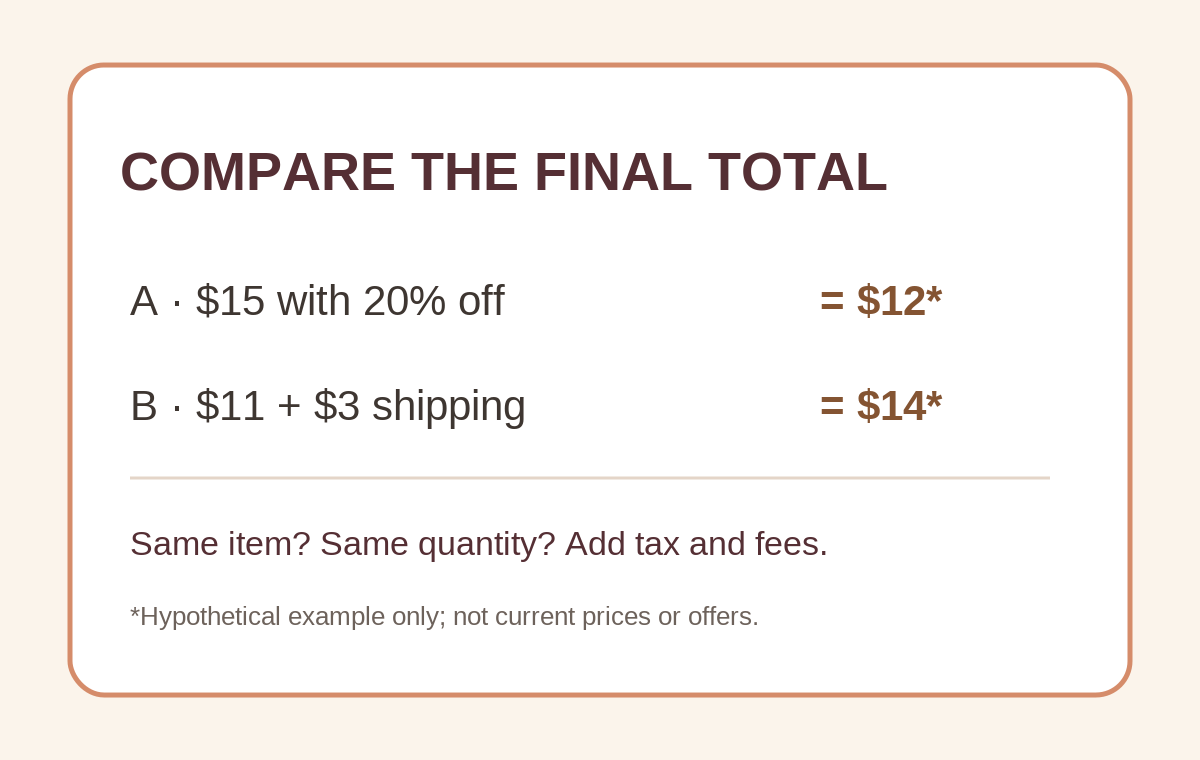
In a made-up example, Offer A is $15 with 20% off ($12 before tax). Offer B is $11 plus $3 shipping ($14 before tax). Offer A is lower in this example. These numbers are invented only to show the arithmetic; they are not current offers, prices, or a promise that the discounted item is best.
Set a stop rule before you browse
Decide what you can spend before opening the sale page. If the item is not already on the list or the final amount does not fit the budget, it is okay to close the tab. A discount on something you do not need is still money leaving the account. If you are unsure, save the link and revisit it later rather than borrowing from a bill or a savings goal.
Use the one-minute comparison
Write “A: final total / amount needed” and “B: final total / amount needed.” If one offer is not clearly better after fees and quantity, choose the one that fits your needs—or skip both. For grocery packages, see my separate guide to checking unit price and package size. For a tempting impulse purchase, the family-budget pause list gives you a little breathing room.
Consumer.gov’s shopping lesson recommends adding shipping to an online price before deciding whether it is a deal. The example above follows that same final-total idea; taxes, fees, and return rules still vary by seller and location. See the Consumer.gov shopping lesson.